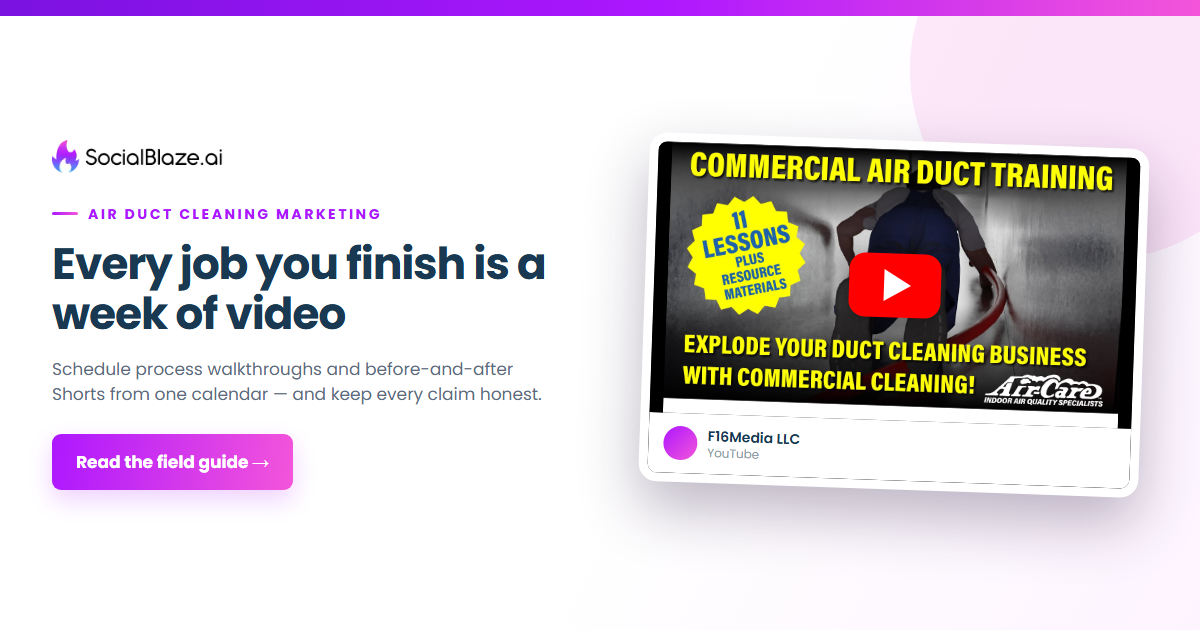

Every job you finish is a video that books the next three
The before-and-after of a filthy return line, the lint pulled from a clogged dryer vent, the camera-on-a-rod tour through a supply trunk — each one answers a question a homeowner is typing into YouTube right now. Here is how to put all of it on one calendar so your long-form videos and Shorts keep selling while your crew is on the next job.

Naomi Brooks
Air duct cleaning YouTube scheduling guide · October 2026
·
13-minute read
Ready-to-edit example
Measurement plan
@F16Mediaofficial
A lead-focused case for making the work visible — the steady, compounding kind, not the one-hit-wonder kind.
Real video · @F16Mediaofficial on YouTube
If you clean residential and commercial air ducts or dryer vents, your single most underused marketing asset is the thing your crew does every day and almost never records — the job itself. The lint snake pulled from a dryer line, the camera-on-a-rod crawling a supply trunk, the before-and-after of a return register that had not been touched since the house was built: these are not just satisfying to watch, they are the exact things a homeowner searches for on YouTube before they decide whether duct cleaning is worth paying for. YouTube is the second-largest search engine in the world and the place people go to understand a service before they buy it. The work is never the problem. The problem is that your lead tech is halfway up an attic ladder with a vacuum running, and nobody is going to stop mid-job to edit a video and write a description.
Run two YouTube formats and let a scheduler carry both. Record long-form process walkthroughs that teach — how a duct cleaning actually works, how often it is really needed, what a dryer-vent inspection looks for — and cut quick before-and-after Shorts from the same footage. Film across a handful of jobs with the customer’s written permission, then load a week or a month of uploads into one calendar on a slow afternoon and let them publish on their own. Keep every claim honest and the footage focused on the equipment, not the household.
Key takeaways before you read further
Why YouTube rewards a duct cleaner more than almost any other trade
We have watched a lot of home-services marketing, and air duct cleaning sits in an unusually lucky spot on YouTube: the work is intensely visual, the result is genuinely hard to see with the naked eye, and the customer almost always has questions they would rather answer on their own before they call anyone. That combination is tailor-made for video. A homeowner cannot inspect the inside of their own supply trunk, so when they wonder whether their ducts are actually dirty, they do what everyone does now — they search YouTube and watch someone else’s ducts get cleaned.
That means you are serving two kinds of viewer at once. The first is the researcher who does not yet know whether duct or dryer-vent cleaning is even worth it — long-form walkthroughs and honest “how often do you really need this” videos do that work, teaching patiently and earning trust without a hard sell. The second is the scroller who gives you three seconds, and for them a before-and-after Short carries the whole message. Pair your YouTube presence with the places people book, and the loop closes: your Facebook page holds your local reviews and your Google Business Profile catches the person searching “duct cleaning near me” today.
The mistake we see constantly is treating long-form and Shorts as two separate projects. They are not. One well-filmed job — the dirty before, the camera-rod tour, the equipment running, the clean after — is a single body of footage you reshape into a teaching video and several Shorts. Scheduling is what turns one recorded afternoon into weeks of presence, which is why a dependable scheduler earns its keep fast for a duct cleaning company whose crew is never free at posting time.
Channel makeover
A fictional but realistic air-duct-cleaning YouTube channel, before and after applying our recommendations
BEFORE → AFTER
@ductguy
We clean ducts. Call for a quote.
4 videos · 60 subscribers · no playlists, no links, shaky phone clips
@cleanair.ductco
Residential & commercial air duct and dryer-vent cleaning in [metro]. Honest process walkthroughs, real before-and-afters, straight answers on how often you actually need it. Book ↓
48 videos · growing local subscriber base · playlists by job type, booking link in every description
Teardown: a lead-focused case for showing the work
F16Media LLC — a channel publishing marketing and lead-generation guidance aimed at air duct cleaning and HVAC businesses
REAL CASE STUDY
Why this one works
Judging by its title — “How To Generate AIR DUCT CLEANING LEADS? | How to get HVAC Leads?” — this video treats filling the schedule as a solvable marketing problem rather than a matter of luck, and that framing is the whole lesson for a YouTube calendar. A duct cleaner’s best lead magnet is not a clever ad, it is the work itself made visible: the before-and-after, the camera-rod tour, the honest walkthrough that answers the questions a homeowner is already searching. The transferable idea is not to copy any single tactic wholesale — your market, your crew and your pricing are specific to you — it is the mindset that leads come from consistently publishing proof and answers, not from one viral clip. A steady library of teaching videos and before-and-after Shorts keeps surfacing for homeowners who find you months from now, which is exactly what scheduling consistently is designed to produce. We have not watched every second, so treat our read as an informed inference from how the video presents itself rather than a frame-by-frame verdict.
Steal this: Commit to one honest process walkthrough and a handful of before-and-after Shorts every week and let them compound, instead of waiting for a perfect viral idea.
The videos that turn a curious homeowner into a booked inspection
Lead with the process walkthrough, because teaching is what builds trust in a trade that has a reputation problem. Show how a duct cleaning actually happens start to finish: the inspection, the camera on the rod, the negative-air setup or the contact-cleaning brushes, the registers coming off, the system running, the honest before-and-after. Narrate what you are doing and why. A viewer who watches you work through one job carefully comes away believing you will treat their home the same way — and that belief is worth more than any discount. Build a long-form walkthrough into the calendar regularly, rotated across residential duct work, commercial systems and dryer-vent jobs so the channel shows range.
Then cut Shorts from that same footage. The before-and-after is your workhorse: the grimy return beside the clean one, the lint pulled from a dryer line laid out on a drop cloth, the dust in the camera view clearing as the brush passes. These stop the scroll because the proof is instant and undeniable — no claim needed, just the visible difference. Pair them with quick-answer Shorts to the questions you get on every estimate: “how often should I clean my ducts,” “do I need this if I just moved in,” “what does a clogged dryer vent actually look like.”
Round it out with genuine education: dryer-vent safety done responsibly — lint buildup is a known fire-safety concern and the manufacturers and fire authorities say so, so you can speak to it plainly without inventing statistics or scaring anyone. Keep air-quality talk general and honest: cleaning removes dust and debris, it does not cure allergies or diseases, and saying so builds more credibility than overclaiming ever could. Your Instagram and TikTok queues can pull from the same clips with captions tuned to each audience.
Greenfox Air Quality’s “HVAC Air Duct Cleaning 101… YOU MUST KNOW THIS!” is exactly the teach-first energy we’d bottle for a channel — an operator walking a viewer through what duct cleaning really involves is the kind of honest, process-led video that makes a homeowner trust the company before they ever request a quote. @GreenfoxAirQuality on YouTube
Reading the numbers that actually fill the schedule
Here is where a lot of operators quietly fool themselves: they watch the view counter on a satisfying before-and-after and call it marketing. Views do not climb into the attic. On YouTube the metrics closest to a booking are the ones to watch — average view duration and retention on your long-form walkthroughs, subscribers gained after a strong video, clicks on the link in your description, and the comments that start with “do you service” a particular area. We tell every duct cleaner to treat raw views as a weak signal, useful mainly for spotting which kind of footage earns attention from homeowners near you.
Watch time deserves special weight, because it is what YouTube itself rewards and what tells you a video is genuinely teaching rather than just flashing a thumbnail. A long walkthrough that holds people to the end is doing the trust work a single Short cannot. Shorts, by contrast, are judged on the swipe — did people watch to the loop, did they tap through to your channel — so measure them on reach and channel visits, not on depth. And treat the question comments as gold: “how much for a two-story,” “do you do dryer vents too,” “are you near [town]” are homeowners moving toward a booking in public.
The practical move is to review all of it in one place each week, note which videos preceded real inquiry calls, and feed that back into the next calendar. If your dryer-vent safety videos pull the questions but your commercial walkthroughs pull the longer watch time, you build more of each into the slots that suit them. A scheduler with built-in analytics closes that loop; if you want the broader framework, our social media scheduler guide walks through it step by step.
How to film a before-and-after on a live job
Three steps, one phone, the customer’s permission first
QUICK START
SocialBlaze helps you plan, write, and publish across every platform — free to start.
What a sample content week looks like
A workable week for a duct cleaning company assumes your crew is out on jobs and nobody is posting live from an attic. Everything here is filmed across a few appointments, with the customer’s consent, and scheduled in one sitting. We anchor the week on Tuesday with a long-form walkthrough, when homeowners researching the service have the attention to actually watch and learn.
Your weekly content rhythm
A repeatable seven-day framework you can start using tomorrow
SAMPLE CALENDAR
Your first four weeks
Week 1: Build the footage library
Spend this week turning filming into a crew habit rather than an afterthought. On every job, with the customer’s written permission, capture three things: the honest before, a few clips of the actual cleaning process pointed at equipment only, and the clean after. Make consent routine — a quick line to the homeowner that you film the ducts and the work, never their belongings, their mail or their family — and keep it respectful every time. By the end of the week you should have footage from a handful of residential, commercial and dryer-vent jobs banked. Set the channel up properly too: a clear description of what you do and where, playlists by job type, a working booking link in every description, and channel art that looks like a real local business. Then schedule the coming week from what you shot. The goal is not views yet — it is never again finishing a jaw-dropping before-and-after that nobody recorded.
Week 2: Establish the rhythm
Now you publish on schedule and watch what happens. Keep the Tuesday long-form walkthrough sacred and fill the rest from your growing library of Shorts. Start rotating job types deliberately — a residential duct cleaning one week, a commercial system the next, a dryer-vent safety piece, a quick-answer Short — so the channel reads as a full-service company rather than one job on repeat. Reply to every comment quickly, because a question like “do you service [town]?” is a buying signal with a short shelf life, and a prompt answer wins the call. Note which videos draw real logistics questions — price, area, scheduling — versus which just draw “oddly satisfying” comments, because questions are homeowners moving toward a booking and applause is only applause.
Week 3: Lean into what books
Three weeks in, patterns appear. Maybe your before-and-after Shorts rack up views while your honest “how often do you really need it” videos pull the actual inquiry comments. Maybe your dryer-vent safety content travels furthest because it speaks to a real, widely understood concern. Rebalance the calendar toward whatever generates real calls and move the pure-satisfaction clips into supporting slots. This is also the week to deepen your teaching: make longer, more thorough walkthroughs for the researchers who watch before they buy, since YouTube rewards watch time and those viewers convert at a higher rate than a casual swipe. Keep every claim honest — cleaning removes dust and debris, it is not a cure for anything — because the credibility of a careful, non-exaggerating channel is itself a competitive advantage in this trade.
Week 4: Systematize and scale
By now the loop should feel automatic: film across jobs with consent, batch on a slow afternoon, schedule the week, review the numbers on Monday. Formalize it. Build a simple three-shot habit every tech keeps in mind — before, process, after — so capture never depends on the owner being on site. Set a recurring block for batching and keep a running folder of clips so a slow week never leaves the channel empty. Get ahead of your seasonal swings too: dryer-vent demand tends to rise in cooler months and duct interest around spring and heavy-use seasons, so queue the relevant education before the phones get busy, because scrambling to publish during your busiest fortnight is exactly when you have the least time. The aim is a marketing engine that runs on the jobs you already complete and an hour of scheduling, not on you finding spare evenings after a full day in the field.
Frequently asked questions
Should an air duct cleaning company really be on YouTube?
Yes, and arguably more than most trades. Duct cleaning has two things that make it ideal for YouTube: the work is dramatically visual, and the customer genuinely cannot see the result for themselves, so they research it on video before they buy. People search “how often should I clean my air ducts” and “what does a dirty duct look like” constantly, and YouTube is where those searches land. A channel of honest walkthroughs and real before-and-afters answers those questions and earns trust in an industry that has a reputation problem to overcome. You do not need production polish — a steady phone, clear narration and the customer’s consent to film the work are enough. A scheduler lets you keep the channel fed without pulling a tech off a job to upload, which is the practical barrier that stops most companies from ever starting.
What’s the difference between long-form videos and Shorts for us?
They do different jobs, and you want both. Long-form walkthroughs — a full duct or dryer-vent cleaning start to finish, or an honest explainer on how often the service is really needed — are your trust-builders. They reach the researcher who watches before buying, and YouTube rewards the watch time they earn. Shorts are your attention magnets: a ten-second before-and-after or a one-line answer to a common question, built to stop a scroll and send people to your channel. The smart move is to film one job thoroughly, cut the long walkthrough from it, and carve several Shorts out of the same footage. One recorded afternoon becomes a week of uploads across both formats, and a scheduler lets you queue them so they publish steadily instead of all at once.
How often should we publish?
Aim for one strong long-form video a week plus two or three Shorts, and treat consistency as more important than volume. A reliable weekly rhythm teaches the algorithm and your subscribers that you are an active, real business, which does far more than a burst of ten uploads followed by three silent months because the season got busy. Since every job produces footage — a before, the process, an after — hitting that cadence is realistic once filming becomes routine for the crew. Batch the whole week in one sitting and let the scheduler publish at sensible times, so a fully booked stretch never knocks you off rhythm exactly when demand is highest and homeowners are searching hardest for someone who looks established and trustworthy.
How do we film inside customers’ homes without crossing a line?
Consent first, equipment only, always. Before you film anything, ask the property owner and get a clear yes — a short written permission line on the work order is ideal, and most homeowners agree once you explain that only the ducts and the work go online, never their home. Point the camera at registers, trunks, dryer lines and your equipment, and keep faces, mail, photographs, children and anything identifying out of frame. For commercial jobs, get the facility manager’s sign-off and avoid capturing people, badges or sensitive areas. If anyone says no, you simply do not film that job — there is always another. Done this way, filming becomes a non-issue, and some customers will happily let you feature a striking before-and-after precisely because you asked and kept it about the equipment.
How do we talk about air quality and dryer-vent safety honestly?
Stick to what is true and verifiable, and skip the fear and the miracle cures. On air quality, be straightforward: cleaning removes accumulated dust and debris from the system, and that is a reasonable thing to want — but it is not a treatment for allergies, asthma or any illness, and claiming otherwise is both false and a credibility risk. On dryer vents, you can speak plainly because the fire-safety concern around lint buildup is widely recognized by manufacturers and fire authorities; you do not need to invent statistics or stage a scary scenario to make the point. Never fabricate numbers, never imply a health outcome you cannot stand behind, and never use scare tactics to pressure a booking. The companies that represent the work accurately win the customers who stay, and in a trade with trust issues, honesty is the strongest marketing you have.
Turn finished jobs into a full channel
You already create the footage on every job — the only missing piece is a place to plan it and a way to publish it without pulling a tech off the next appointment. Load a week of walkthroughs and before-and-after Shorts into SocialBlaze on a slow afternoon and let it carry your duct cleaning company across YouTube and your other networks while your crew stays out on the work.

Naomi Brooks writes practical social media field guides for small businesses at SocialBlaze — the organic social media scheduling and analytics platform built for independent brands.
Case-study videos are embedded from their creators’ public accounts and remain the property of their creators. Figures mentioned reflect publicly visible information at the time of publication (October 2026). SocialBlaze is an organic social media management tool — it does not run ads or manage paid campaigns.